Most people choose careers based on opportunity, qualification, or convenience.
Very few choose based on how their brain naturally prefers to work.
And that’s one of the biggest reasons capable people end up feeling frustrated, drained, or “out of place” at work, even when they’re good at what they do.
PRISM Brain Mapping shows us something simple but powerful:
We all use the whole brain, but most of us lead with certain behavioural quadrants more than others. These preferences shape how we think, communicate, solve problems, and respond to pressure.
When your career aligns with those preferences, work tends to feel easier and more sustainable.
When it doesn’t, everything feels harder than it needs to be.
The Four Quadrants A Quick Reminder
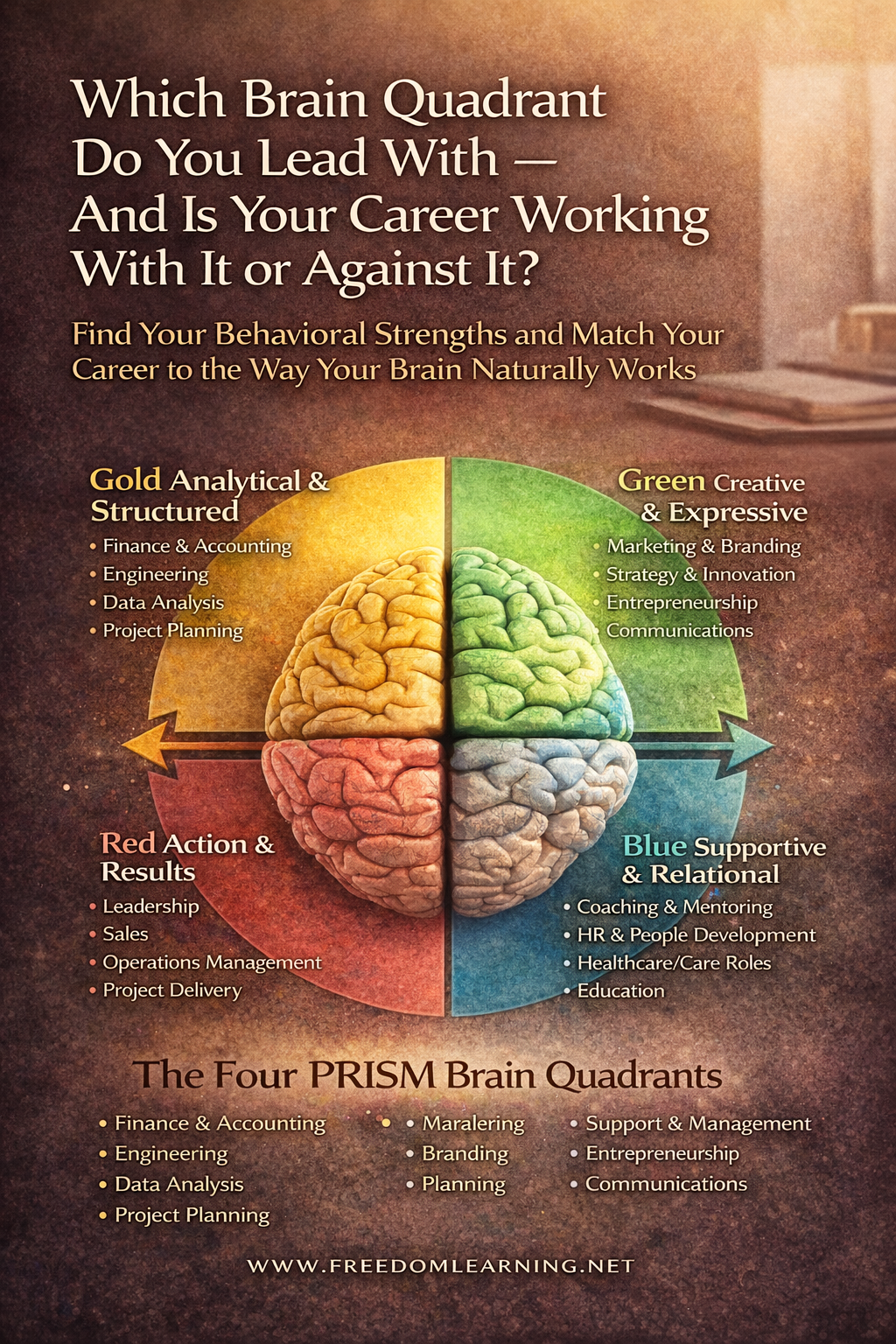
PRISM identifies four main behavioural processing styles. You’ll usually lead with one or two.
Here’s a simple way to think about them:
🟡 Gold - Analytical & Structured
Gold-dominant people naturally gravitate toward:
· analysis
· structure
· accuracy
· planning
· logical problem-solving
They tend to enjoy work that involves data, systems, precision, and careful thinking.
🟢 Green - Creative & Expressive
Green-dominant people are drawn to:
· ideas
· innovation
· communication
· strategy
· possibility thinking
They thrive in roles that involve creativity, vision, storytelling, and influencing others.
🔴 Red - Action & Results
Red-dominant people prefer:
· execution
· decision-making
· leadership
· momentum
· achieving outcomes
They perform well in fast-paced, results-driven environments where progress and delivery matter.
🔵 Blue - Supportive & Relational
Blue-dominant people value:
· relationships
· collaboration
· stability
· care
· emotional awareness
They often thrive in people-focused roles where empathy, service, and team harmony are important.
None of these is better than the others.
They simply suit different kinds of work.
Why Career Fit Matters More Than Job Titles
Let’s make this practical.
Imagine someone with very low Gold (analytical) preference choosing a career in accounting or audit.
They might be intelligent. They might be capable. They might even succeed.
But the work itself detail-heavy, structured, accuracy-focused will often feel draining rather than energising.
Now imagine a strongly Green or Yellow-oriented person forced into repetitive, rigid work with little creativity or interaction.
Again, they might cope. But they won’t thrive.
This isn’t about competence.
It’s about natural behavioural fit.
Simple Real - World Examples
Here are a few basic illustrations to get you thinking:
If you lead strongly with Gold:
You may naturally enjoy roles involving:
· finance and accounting
· engineering
· data analysis
· quality control
· project planning
These environments reward structure, accuracy, and careful thinking.
If you lead strongly with Green:
You may thrive in roles such as:
· marketing and branding
· strategy and innovation
· product development
· entrepreneurship
· communications
These roles reward ideas, vision, and creative thinking.
If you lead strongly with Red:
You may perform best in:
· leadership roles
· sales environments
· operations management
· project delivery
· performance-driven roles
These roles reward action, decisiveness, and delivery.
If you lead strongly with Blue:
You may naturally suit:
· coaching and mentoring
· HR and people development
· healthcare and care roles
· education
· customer experience
These roles reward empathy, support, and relationship-building.
Again this is not rigid. Most people combine two dominant quadrants, which creates even more nuanced career matches.
Why People Often End Up Misaligned
Most of us were never taught to think about work this way.
We were taught to ask:
· What pays well?
· What qualifications do I have?
· What jobs are available?
Rarely:
· How does my brain prefer to work?
· What environments bring out my best thinking?
· What type of pressure suits me?
So people adapt. They push through. They compensate.
And eventually many reach a point where they realise:
“I can do this but it doesn’t really fit me anymore.”
This Is Where PRISM Career Reset Comes In
The PRISM Career Resetdoesn’t guess your preferences.
It measures them.
Using neuroscience-based behavioural mapping, it identifies:
· your dominant quadrants
· how you respond under pressure
· how you process information
· how you prefer to work
· what environments suit you best
It then helps match that profile to career paths, roles, and work styles that align with your natural strengths.
This isn’t about changing who you are.
It’s about working with how you’re wired instead of against it.
👉 You can learn more about the PRISM Career Reset here: https://www.freedomlearning.net/prism-career-reset
A Simple Question To Leave You With
If you’re honest with yourself:
Does your current role reward how your brain prefers to work or does it constantly ask you to compensate?
That answer matters more than most people realise.
Final Thought
When people understand their behavioural strengths, careers stop being about forcing success.
They become about alignment.
And alignment changes everything.